

There is a small trick at the centre of Ringfall’s handling, and I am proud of it. An order you give does not run the moment you give it. The simulation waits a few ticks first, because that is what a lockstep game needs so that every PC in a match runs the same battle. What you see, though, answers at once: the click marker lands, the order line draws, the unit acknowledges. By the time the order actually runs, your hand has already moved on. The delay is real. You never feel it.
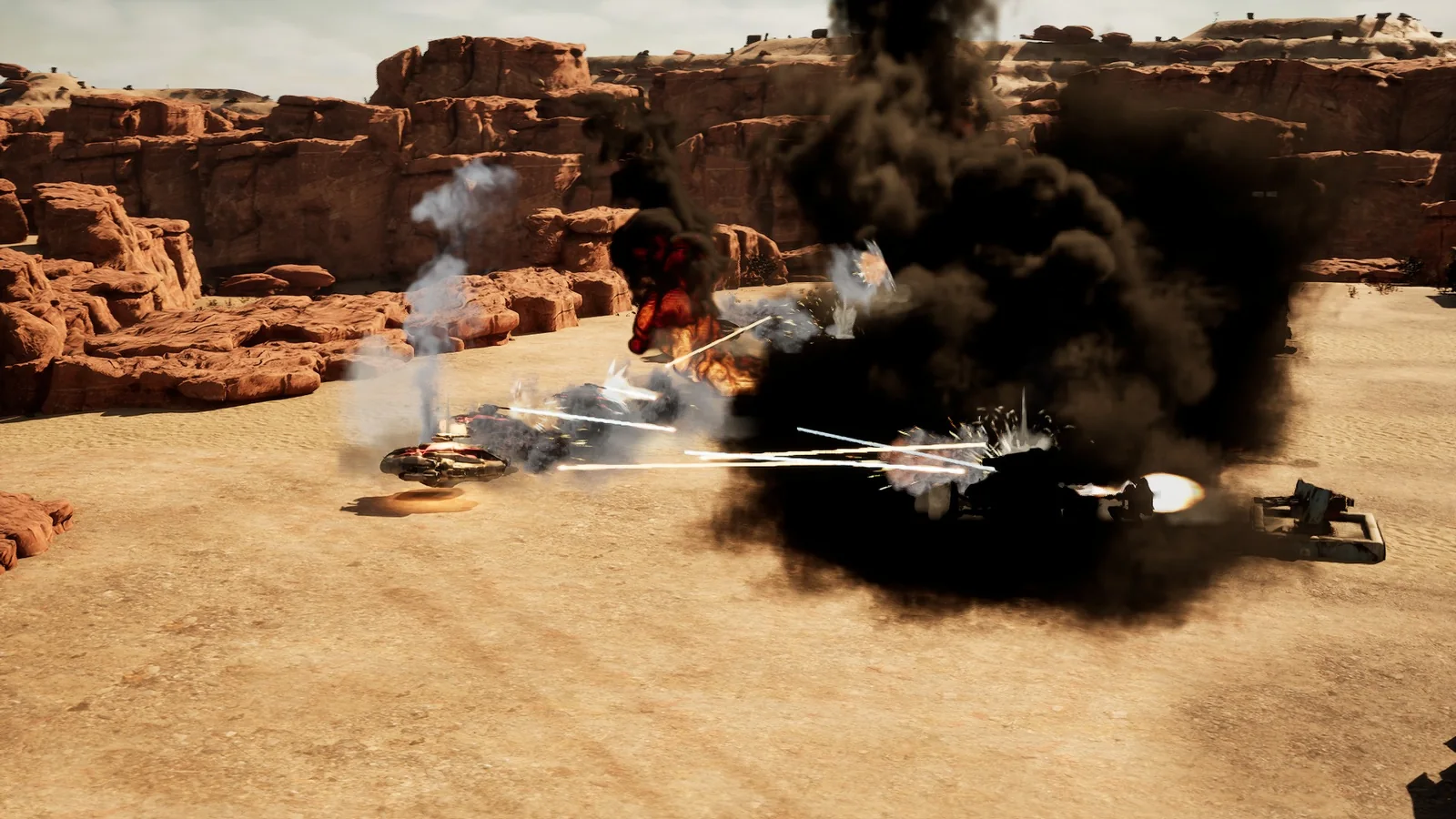 In-game. Orders going out on the Fallen Frontier.
The line shows the real route
The order line is not a straight line to where you clicked. It is the path the unit will actually take, round the cliff, through the pass, because a line that lies is worse than no line at all. Move, attack-move and attack each draw in their own colour, so a glance at the ground tells you what you asked for before anything has moved.
Small comforts
Double click selects every unit of that type. One key selects the whole army, another every harvester. Active pause stops the clock and keeps taking orders, so you can think without the game thinking faster than you. Idle units guard their post and return fire. Harvesters run from danger and go back to work on their own. One key scatters a selection out of a blast radius, which you will learn the first time the sky falls on your tanks.
Why I care this much
Because it is the whole bet. The game page says the simulation was built for responsiveness first and everything else second, and that is not a slogan. It decided the architecture, the lockstep delay, the fixed-point maths, the order the features were built in. Every time I play a build and a click lands late, I go and find out why before I touch anything else, and some of my least glamorous weeks have gone into exactly that. The next dispatch is about what happens underneath, for the curious.