

The roadmap has a gate before any marketing money is spent: a twenty-minute skirmish against the AI in which the debris impact changes who wins. If the signature mechanic does not decide matches, fix the mechanic before selling it. This is the first measurement, and the short answer is no, not yet.
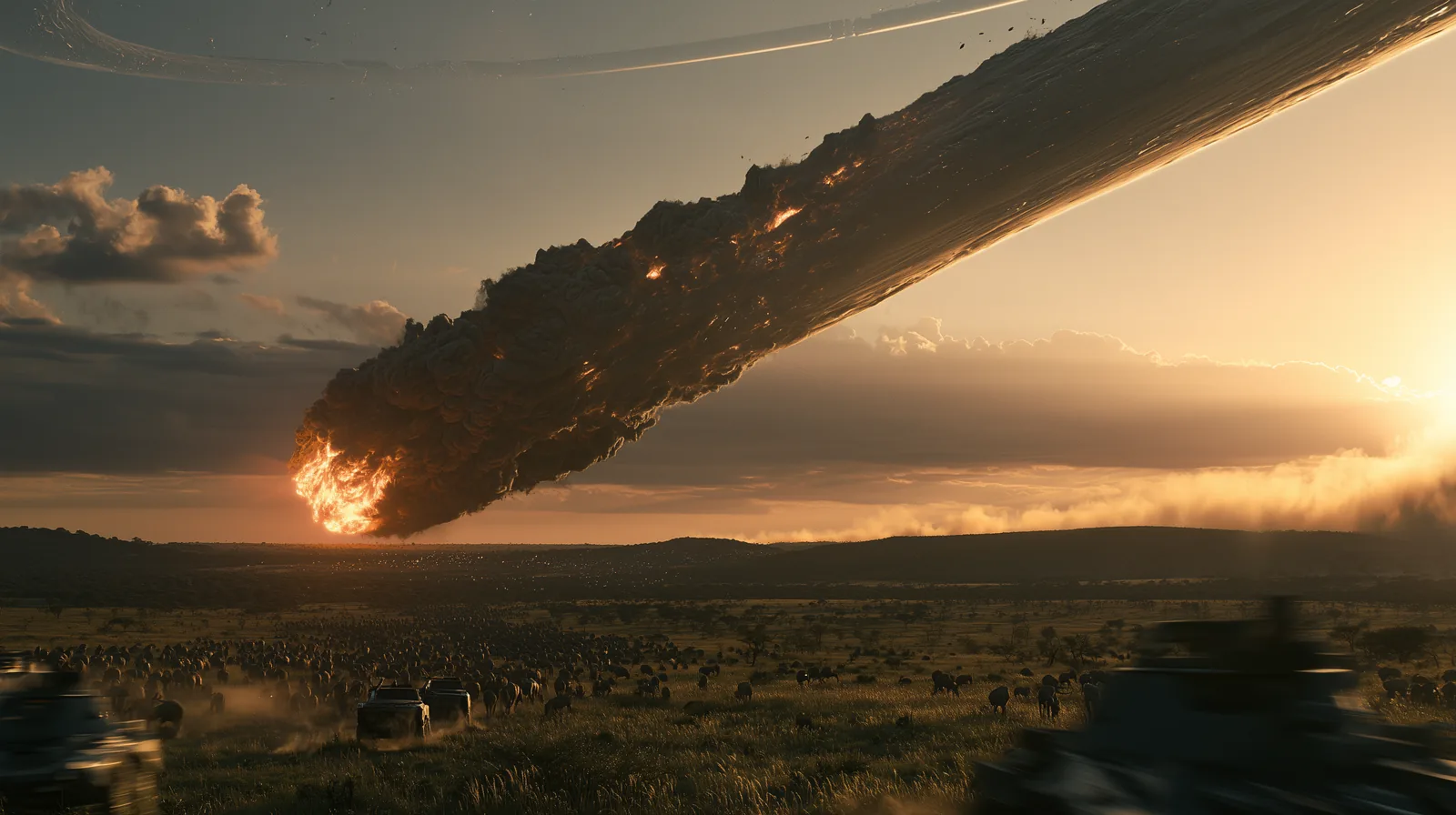 A fragment comes down. Cinematic art; the matches below were played in the gray-box prototype.
How it was measured
Hard AI against Hard AI on the Fallen Frontier, twenty minutes a match. Every match is played twice with the same seed, once with impacts and once with the map’s impact zones removed, so the only difference between the pair is the sky. All four faction pairings, both seats, ten seeds each: eighty matches per setting. Then the same again with the map’s ordinary salvage fields halved, and quartered, because the idea was that players only fight over a crater when nothing is left around them. Four hundred and eighty matches, about four minutes on thirty cores.
What counts: who is ahead at the end; how often switching impacts on flips that, compared with how often simply replaying the same match flips it; how much impact salvage each side actually unloaded; whether any army was ever at a crater; and when each side’s income stalled.
What it said
At normal field amounts the impacts do nothing. A side collects about 150 credits from impact fields in twenty minutes, out of roughly 61,000 harvested. The map holds 319,000 credits of salvage in 25 fields. Three craters of 10,000 to 15,000 are not worth a trip, and switching impacts on changed who was ahead less often than replaying the match did.
Scarcity makes them pay. With fields quartered, the craters are 11 percent of all income and they keep economies alive: without impacts 100 of 160 sides stalled before minute twenty, with them 73. Where impacts flipped a result, they flipped it toward the side that took the salvage, 14 to 2.
But nobody fights over them. In 709 landings across the three settings, both armies were at a crater at the same time exactly never. Armies turned up at 2 to 10 percent of craters, mostly passing through. The landings killed almost nothing, because the AI walks out of the zone during the thirty-second warning, which is at least the right thing to do.
The salvage went by distance, not by decision. The southern base is nearer eight of the nine impact zones than the north-western one, because the zones were laid out for the map’s four bases and an AI duel uses two. The near side took 5,098 credits a match at quarter fields, the far side 1,433. Harvesters simply wandered to the nearest field with salvage left. Nothing sent them, or an army, to a crater.
The faction mix decided more than the sky. The League beat the Consortium in nearly every mixed match. The impacts cannot change that; only mirror matches were close enough to tip. That is a balance problem, and a separate one.
What the first batch taught about seeds
The first run gave every match the same seed, which meant the same three zones in the same order every time, two of them beside one base. That side took 14,000 credits a match and the other nothing, and impacts flipped a fifth of the matches toward it. A crater by one base decides matches for that base. The game now gives every match its own seed, and so does the measurement.
So the gate stays shut
The mechanic is not wrong. Craters that matter when fields are scarce is exactly the design. What is missing is two things the measurement cannot invent: an AI that goes to contest a fresh field instead of wandering to the nearest one, and impact zones placed fairly for the two bases that are actually playing. Both are on the list. The gate gets measured again when they are in, with the same 480 matches, and this dispatch gets a sequel either way.